

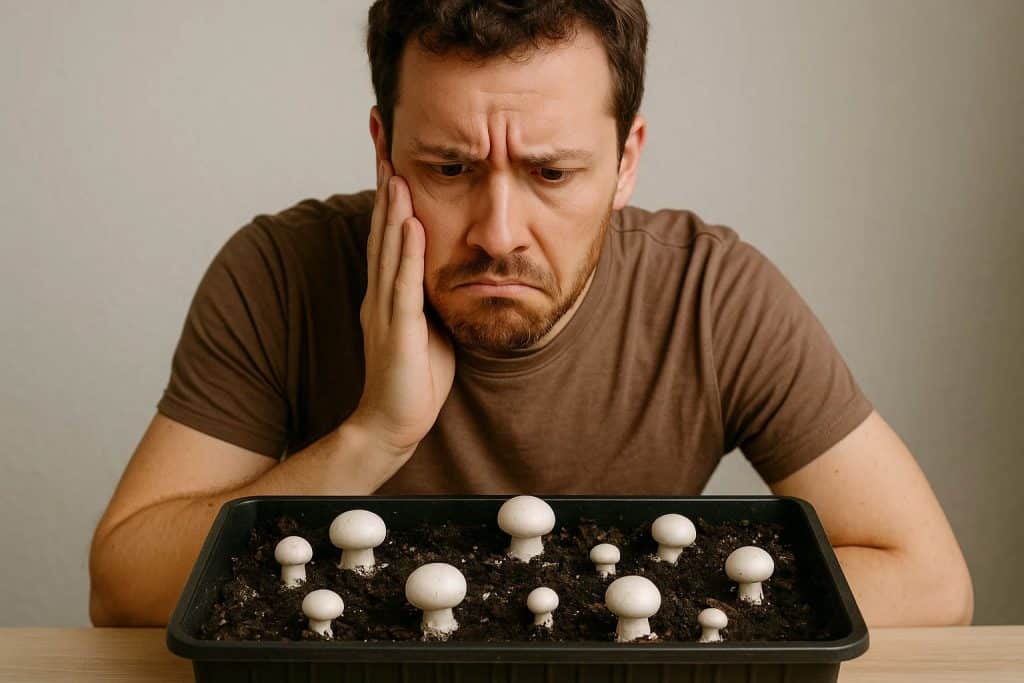
Growing mushrooms at home can be incredibly rewarding, but many beginners make simple mistakes that can completely destroy what should have been a bountiful harvest. The frustration of watching your carefully tended mushroom kit turn into a moldy mess, or waiting weeks for mushrooms that never appear, often stems from just a few critical errors that are easily preventable once you understand what’s happening.
The difference between success and failure in mushroom cultivation often comes down to understanding that fungi operate by completely different rules than traditional plants. While your houseplants might forgive irregular watering or temperature fluctuations, mushrooms are far less forgiving. They’re essentially the fruiting bodies of a vast underground network of mycelium—think of them as the “apples” of an invisible fungal “tree.” This mycelium is constantly responding to environmental cues, deciding whether conditions are right to produce mushrooms or whether it should retreat and wait for better times.
Whether you’re working with your first oyster mushroom kit from the kitchen counter, attempting to inoculate shiitake logs in your backyard, or trying your hand at more advanced species like lion’s mane or reishi, the same fundamental principles apply. Get the basics wrong, and you’ll find yourself dealing with contamination, failed flushes, or mushrooms that taste terrible. Get them right, and you’ll be amazed at how prolifically and consistently your fungi will produce.
The stakes are particularly high because most mushroom growing mistakes don’t just reduce your yield—they can completely sabotage the entire growing cycle. A contaminated kit doesn’t just produce fewer mushrooms; it produces none at all and may even pose health risks. Poor environmental conditions don’t just slow growth; they can cause the mycelium to stall permanently or produce deformed, inedible fruiting bodies.
Understanding and avoiding these common pitfalls will dramatically improve your success rate and help you grow beautiful, healthy mushrooms flush after flush. More importantly, it will give you the confidence to experiment with different species and techniques as you develop your mycological skills.
Overwatering or Underwatering Your Growing Medium
The Mistake: Many new growers either spray their mushroom kits multiple times a day thinking “more water equals more mushrooms,” or they forget to maintain proper moisture levels entirely.
Why It Happens: Mushrooms need consistent humidity, but the balance between too wet and too dry can be tricky to master.
How to Avoid It: Most mushroom kits need misting 2-3 times per day with a fine spray bottle. The growing medium should feel damp to the touch but not soggy. If you can squeeze water out of your substrate, you’ve gone too far. Create a humidity tent with a clear plastic bag or use a humidity chamber to maintain consistent moisture without direct over-spraying.
Pro Tip: Invest in a hygrometer to monitor humidity levels. Most mushrooms thrive at 80-90% humidity during fruiting.
Poor Temperature Control
The Mistake: Placing mushroom kits in areas that are too hot, too cold, or experience dramatic temperature swings throughout the day.
Why It Happens: People often assume mushrooms grow best in warm conditions or don’t realize how sensitive they are to temperature changes.
How to Avoid It: Different mushroom varieties have specific temperature requirements. Oyster mushrooms prefer 60-75°F, while shiitake likes it slightly cooler at 55-70°F. Avoid placing kits near heating vents, in direct sunlight, or in basements that get very cold. A consistent room temperature area away from temperature extremes is usually perfect.
Pro Tip: If your home runs hot or cold, consider using a small heating mat with a thermostat controller for precise temperature management.
Contamination from Poor Sterile Technique
The Mistake: Not washing hands before handling kits, using dirty tools, or working in dusty environments, leading to mold or bacterial contamination.
Why It Happens: Beginning growers underestimate how easily contaminants can overtake mushroom cultures, especially during the vulnerable early stages.
How to Avoid It: Always wash your hands thoroughly before handling any mushroom growing materials. Clean your workspace and tools with isopropyl alcohol. Work away from open windows, fans, or high-traffic areas where spores and bacteria circulate. If you see green, black, or orange mold growing instead of mushrooms, you’ve likely got contamination.
Pro Tip: Keep a spray bottle of 70% isopropyl alcohol handy and wipe down surfaces before each session. Consider wearing gloves when handling substrate or making cuts.
Inadequate Air Exchange
The Mistake: Sealing mushroom kits in completely airtight containers or, conversely, exposing them to too much direct airflow.
Why It Happens: The concept of “fresh air exchange” confuses many beginners who either try to create a completely sealed environment or think mushrooms need constant air circulation like plants.
How to Avoid It: Mushrooms need fresh air exchange to prevent carbon dioxide buildup, but gentle, indirect airflow is key. If using a humidity tent, leave small gaps or poke tiny holes for air exchange. Avoid placing kits directly in front of fans or air conditioning units. The goal is subtle air movement, not a constant breeze.
Pro Tip: Fan your mushroom growing area gently with a piece of cardboard 2-3 times per day to encourage fresh air exchange without creating harsh drafts.
Harvesting Too Early or Too Late
The Mistake: Picking mushrooms when they’re still tiny buttons or waiting until the caps have completely flattened and started dropping spores.
Why It Happens: New growers either get impatient and harvest too early, or they wait for mushrooms to get as large as possible, thinking bigger is better.
How to Avoid It: Harvest most mushrooms when the caps are still rounded but have reached a good size—typically when they’re about 2-4 inches across for oyster mushrooms. The caps should still be curved downward, not flat. For shiitake, harvest when the caps are 80% open but still slightly curved. Once caps flatten completely, the mushrooms become tough and less flavorful.
Pro Tip: Harvest entire clusters at once by cutting at the base with a clean knife rather than picking individual mushrooms. This prevents damage to remaining pins and encourages better subsequent flushes.
Ready to Start Growing?
Avoiding these five common mistakes will set you up for mushroom growing success from day one. Remember that mushroom cultivation is part science, part art—don’t be discouraged if your first few attempts aren’t perfect. Each growing cycle teaches you something new about creating the ideal conditions for your fungi friends.
Looking for quality mushroom growing supplies? Check out our selection of beginner-friendly growing kits, professional-grade tools, and everything you need to start your mycology journey right. With the right equipment and knowledge, you’ll be harvesting delicious homegrown mushrooms in no time.
